Working with real estate investors can feel intimidating, especially if most of your experience has been with traditional buyers and sellers. Investors ask different questions. They use different terminology. And instead of focusing primarily on whether they love a property, they want to know whether the numbers work.
That can make agents feel like they need to become financial experts before they can confidently work with investors. They don’t.
You don’t need to know everything. You need to understand how investors evaluate opportunities, speak their language, and develop a reliable process for helping them make informed decisions.
The goal isn’t to become the smartest person in the room. It’s to become a valuable resource. Here’s how to start.
Learn the Math
Investor conversations almost always come back to the numbers. If you can quickly understand the financial picture of a property, you can have a much more meaningful conversation with an investor.
Start by mastering a few of the fundamentals:
- Net Operating Income (NOI): The income a property generates after operating expenses but before debt service.
- Cap Rate: A way to measure a property’s return based on its NOI and value.
- Cash-on-Cash Return: The annual cash flow an investor receives compared with the amount of cash they actually invested.
You don’t need complicated financial models to get started. Practice running these calculations on properties in your market until they become second nature.
When an investor sends you a listing and asks, “What do you think?” you want to be able to respond with more than sales comps. You want to help them understand what the investment itself looks like.
Learn the Language
Real estate investors have their own vocabulary, and understanding it makes investor conversations much easier.
Learn terms like BRRRR (Buy, Rehab, Rent, Refinance, Repeat), ARV (After Repair Value), DSCR (Debt Service Coverage Ratio), value-add, rent roll, cash flow, and leverage.
More importantly, understand what those concepts mean in practice.
If an investor says they’re looking for a value-add property they can BRRRR, you should immediately understand the general strategy they’re pursuing and the kinds of properties that might fit.
Speaking the language builds confidence on both sides of the conversation.
Understand Property Management
You don’t have to manage rental properties yourself to work effectively with investors, but you do need to understand how property management affects investment performance.
Rental income is only one side of the equation. Vacancy, tenant turnover, repairs, maintenance, management fees, taxes, insurance, and capital expenditures can significantly change a property’s actual return.
An inexperienced investor may look at a property renting for $2,000 per month and immediately think, “That’s $24,000 a year.”
An investor-friendly agent knows that’s only the beginning of the analysis.
Understanding the operational side of rental ownership helps you have more realistic conversations about what a property may actually produce.
Learn to Value Properties the Way Investors Do
This is where many traditional real estate agents miss the mark.
Agents are typically trained to prepare a Comparative Market Analysis (CMA) by looking at recent sales of similar properties. That’s an important tool, particularly when determining what buyers in the market may be willing to pay.
But investors may look at the same property differently.
They’re not only asking, “What are similar properties selling for?”
They’re also asking, “What is this property worth based on the income it can produce?”
That’s where the Income Approach becomes important.
A basic income valuation starts with the property’s gross rental income. From there, you account for realistic vacancy and operating expenses such as taxes, insurance, maintenance, repairs, and management.
What remains is the property’s Net Operating Income (NOI).
The basic formula looks like this:
Property Value = NOI ÷ Market Cap Rate
For example, imagine you’re analyzing a duplex with a $1,800 monthly rent roll. After accounting for vacancy and operating expenses, suppose the property produces $20,800 in annual NOI.
If comparable investment properties in that market are trading around an 8% cap rate:
$20,800 ÷ 0.08 = $260,000
Meanwhile, a traditional CMA based on recent sales might suggest a value closer to $220,000.
Neither number should automatically be treated as the “correct” value. They’re answering different questions, and the assumptions behind the income analysis matter. The difference between those valuations is something an investor will want to understand.
Being able to prepare and explain both a CMA and an income-based valuation immediately changes the conversation.
You’re no longer simply showing someone a property. You’re helping them analyze an investment.
Build a Repeatable Process
Investors appreciate efficiency and consistency. Instead of reinventing your approach every time an investor sends you a property, create a repeatable system.
Your process might look something like this:
- Identify a property that fits the investor’s buy box.
- Research the property and local rental market.
- Run traditional sales comps.
- Estimate realistic rental income and expenses.
- Calculate NOI, cap rate, cash flow, and other relevant returns.
- Present both the sales and income analyses.
- Discuss the opportunity in the context of the investor’s goals.
- Help the investor decide whether the property deserves further due diligence.
The more often you follow the process, the faster and more confident you’ll become.
Eventually, you’ll be able to look at a property and quickly identify the questions that need to be answered before your investor client moves forward.
Invest Yourself — If It Makes Sense for You
One of the most effective ways to understand investors is to become one yourself.
You don’t have to build a huge portfolio. Even purchasing one rental property can teach you lessons that are difficult to learn from a textbook or spreadsheet.
You’ll experience vacancies, repairs, financing, insurance, tenant turnover, maintenance, property management, and all the other realities that come with owning an investment property.
That firsthand experience can also change the way you communicate with investor clients.
Instead of only explaining what you’ve learned in a class, you can say, “I own rental property too. Here’s what I’ve learned.”
That kind of experience can build credibility because you’re dealing with many of the same decisions your clients face.
Of course, buying an investment property isn’t practical or appropriate for everyone. You can still become an excellent investor-focused agent without owning rentals yourself. The important thing is continuing to learn how investment properties actually perform beyond the closing table.
Confidence Comes From Competence
You don’t become an investor-friendly agent by memorizing every possible formula or pretending to know everything about real estate investing.
You become one by developing competence.
Learn the math. Learn the language. Understand property management. Know how to evaluate properties using both traditional sales data and income-producing potential. Then build a process you can repeat every time an investor brings you an opportunity.
The more properties you analyze, the more patterns you’ll recognize. The more investor conversations you have, the more comfortable those conversations will become.
Eventually, the terminology and calculations that once seemed intimidating become part of the way you naturally evaluate real estate.
And that’s when the relationship with your investor clients begins to change.
You’re no longer simply the person who finds properties and writes offers.
You’re becoming the real estate professional investors rely on to help them recognize opportunities, understand the numbers, and make better-informed investment decisions.

The Niche that Makes You Rich
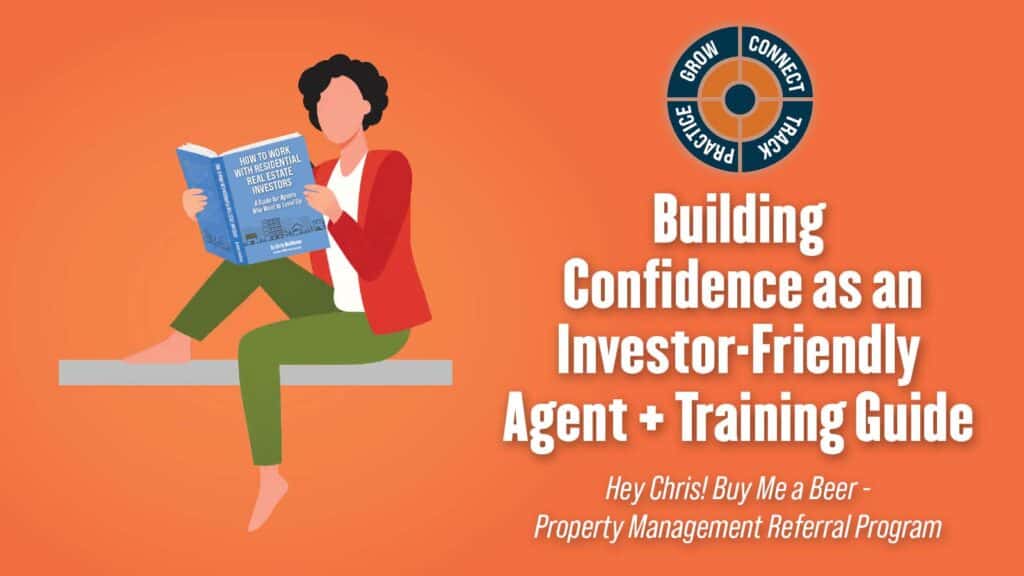
Working with real estate investors really is worth it. Download the guide, “How to Work with Residential Real Estate Investors: A Guide for Agents Who Want to Level Up.”
- Ready to get clarity on your goals for the next 12 months? I’d love to help you figure out how to get from where you are now to where you want to be! Schedule a FREE 45 Minute Coaching Call with Chris McAllister.
- Looking to build a sustainable career that honors both your professional ambitions and personal wellbeing? Download your FREE copy of Protecting the Goose that Lays the Golden Eggs, and learn how to find the right balance at www.TheGooseBook.com.
- Learn how the best real estate professionals among us generate more leads, book more appointments, earn more referrals, and make more money. Listen to the Connect Practice Track & Grow Podcast with your hosts Chris McAllister and Laci LeBlanc at www.ConnectPracticeTrackGrow.com
- Want more practical tips for growing your real estate business? Our ever-growing library of books, blog posts, podcast episodes, masterclasses, documents, and other tools is at your fingertips. Learn More at The All Things Real Estate Resource Hub
- Build a Better Career with ROOST™ Build a career worth having AND a life worth living. Get started at www.CareerWithROOST.com